Blask built this as an informational site for havenaccess.org, an organization dedicated to protecting access to kratom and all of its alkaloids.
It is an opinion site built on public records. Every claim carries a label and a source, so you can check it yourself. Nothing here is medical or legal advice.
Want to do something about it? kratomcalls.com finds your representatives and helps you write to them in your own words.
The Kratom Act of 1943 made Thailand the first country to outlaw the leaf. A 2026 peer-reviewed review of Thai policy says the main motive was economic.
“safeguarding state revenue from opium taxation rather than public health considerations”
Why it matters
The first ban anywhere protected a government's opium revenue. Thailand reversed it in 2021.
Thailand's kratom policy in a comparative global perspective, 2026 review (Study or data, no public link)
Congress gave DEA temporary scheduling power under 21 U.S.C. 811(h) in 1984. Its first use put MDMA in Schedule I in 1985. In 1987 the First Circuit threw out DEA's permanent Schedule I placement of MDMA and sent it back. DEA placed it again in 1988.
Why it matters
The power DEA used on kratom compounds in 2026 starts here. The first drug it touched had its placement thrown out by an appeals court.
Mac Haddow, formerly a senior official at the Department of Health and Human Services, was sentenced on two counts of conflict of interest. Decades later he is the American Kratom Association's lobbyist and public face, and he discloses the conviction himself on its federal lobbying filings.
“9/15/1987, U.S. District Court, 18 U.S.C. Section 208(a), conflict of interest (2 counts)”
Why it matters
It is public, and he put it there. Judge the group's arguments on the record, and know who is making them.
Ponglux and colleagues reported 7-OH as a minor alkaloid in kratom leaf. In the leaf it is a trace compound. Leaf users mostly get their 7-OH when the body converts mitragynine.
Why it matters
Thirty years later the same molecule, concentrated and sold on its own, is what every bill is written around.
A 2025 review describes the US market from about 2004 to 2023 as dried leaf powders, capsules and hydroalcoholic extracts, and notes the absence of isolated 7-OH products before 2024.
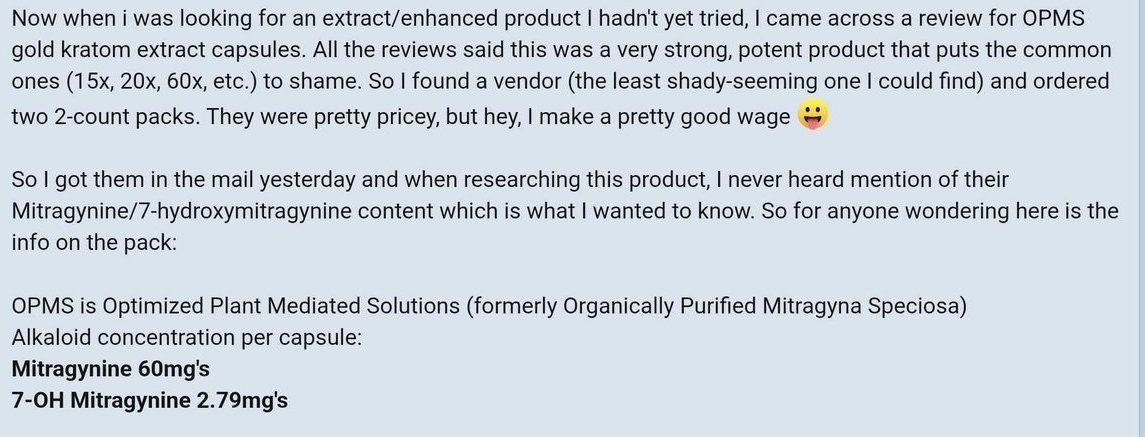
From a forum post dated Aug 11, 2017, quoting an extract pack: 60 mg mitragynine and 2.79 mg 7-OH per capsule. A user's post, not a lab result. It shows what a strong extract claimed before isolates. Cropped to the post text.
Why it matters
Concentrated 7-OH tablets are a new product. The molecule is not: it was in the leaf on these shelves all along, at low levels.
Import Alert 54-15 lets FDA detain kratom shipments without examining them, on the grounds that kratom is a new dietary ingredient without enough information to show it is safe. FDA last revised the alert on Aug 17, 2026. It has never been withdrawn.
Why it matters
The federal fight started at the ports, two years before DEA moved.
CDC published its guideline for prescribing opioids for chronic pain. Doctors and insurers across the country began tapering and cutting off long-term patients.
Why it matters
People cut off from prescriptions went looking for something else. A 2020 survey found many of them in kratom.
DEA announced on Aug 30 and published on Aug 31 a notice of intent to temporarily place mitragynine and 7-OH in Schedule I. The notice cited port seizures, two FDA import alerts, about 30 deaths, and 720 seizure reports from 43 states.
Why it matters
That is the record DEA called an emergency in 2016. The 2026 notice counts 42 seizure reports in 12 states.
A letter from 51 House members, 22 of them Republicans, led by Reps. Mark Pocan and Matt Salmon, asked DEA to delay and open a comment period. Senators wrote too. Veterans, pain patients and consumers flooded the agency.
DEA withdrew its notice of intent (signed Oct 6, published Oct 13) and opened a public comment period through Dec 1. More than 23,000 comments came in.
Why it matters
The only federal emergency move on this plant was stopped before it took effect. Then people filled the record.
Adding the AKA's lobbying disclosures for Haddow's firm from 2017 through 2020, amendments applied, gives $708,000. Courthouse News reported $776,000 for the same work. That is its figure, not ours.
AKA lobbying paid to Haddow's firm, by year
2017$251,000
2018$157,000
2019$150,000
2020$150,000
Total: $708,000, our tally
Why it matters
The money that defends the leaf in Washington runs through one man's firm.
Former Rep. Patrick J. Kennedy, a co-founder of SAM and later of FDPS, was appointed to the board of Braeburn. Braeburn markets Brixadi, an injectable buprenorphine treatment for opioid use disorder.
Why it matters
A board seat at a company selling addiction treatment, held by a co-founder of the groups that want kratom banned. That tie is documented. No record shows a payment from Braeburn to the campaign. SAM says it takes no pharmaceutical money.
University of Florida pharmacologist Christopher McCurdy was among scientists who urged DEA not to schedule kratom. He became the expert both sides cite.
ProPublica, Sep 1, 2026 (Reported, no public link)
FDA Commissioner Scott Gottlieb said an FDA computer model predicted that kratom compounds act on the body's opioid receptors. The agency cited 44 deaths where kratom was found. Its word was associated, not caused.
Why it matters
The word opioid attached to the plant here, from a model's prediction, not a study in people. Every headline since has leaned on it.
Assistant Secretary for Health Brett Giroir wrote DEA reversing HHS's earlier recommendation. Kratom's compounds should "not be controlled at this time, either temporarily or permanently," he wrote, citing "the relative lack of evidence."
Why it matters
The health department DEA needs on board said the evidence was not there, and DEA did not schedule the plant.
FDA required label changes after reports of serious withdrawal, uncontrolled pain, psychological distress and suicide in patients whose opioids were stopped suddenly.
Why it matters
The agency put the harm of cutoffs on the label three years after the guideline that set them off.
In a survey of 2,798 kratom users, 41% (1,144 people) said they had used kratom to stop or reduce opioid use. Of those, 35% reported going more than a year without opioids. Self-reported, from an online sample.
The 2022 guideline warns against abrupt tapering and lists the risks of stopping opioids, including overdose and suicidal ideation and behavior. The same year, a CDC and NIDA funded study of 199,836 patients found overdose or suicide events rose about 15% after tapering (Larochelle). Another found fast dose cuts nearly doubled overdose risk in years two to four (DiPrete).
Why it matters
A 2026 Australian study found the opposite, and its authors point to Australia having no fentanyl supply. The US has one. Being cut off here means the street.
atai reported that KUR-101's Phase 1 breathing result was inconclusive because the oxycodone comparison did not separate from placebo. No Phase 2 has followed.
Under a court warrant, agents seized Feel Free, Botanic Tonics' kratom and kava drink, from a warehouse near Tulsa. FDA reported the seizure Apr 28 and valued it at about $3 million. DOJ filed a civil forfeiture case against the bottles.
UNODC: "Since 2024, novel kratom-related products have emerged." A Yale, Ohio State, Florida and Johns Hopkins team found 304 7-OH or MGPI products marketed online from Sep 2024 to Feb 2025, 82.2% of them 7-OH only.
Why it matters
A new way to sell a kratom alkaloid, apart from the leaf. Everything after this is a fight over who gets to sell what.
Journalist Scott Carney reported that Ross is Jerry Cash and that Ross confirmed it to him. As CEO of Quest Energy Partners, Cash diverted about $10 million and was sentenced to 108 months in federal prison.
University of Florida records obtained by ProPublica show the association bought the ticket for a trip to Indonesia, which was weighing a ban. He canceled and kept the credit. The travel was not disclosed.
Why it matters
Undisclosed money matters. Most of his research money is federal NIDA funding, and he does expert work for both sides. Judge each study on its data.
ProPublica, Sep 1, 2026 (Reported, no public link)
Columbia's license to Kures ended in October 2024 and the company was dissolved in November. The licensed rights returned to Columbia. atai kept certain assets and trial data.
Why it matters
When Lilly buys atai in 2026, it is not buying kratom rights. Those left atai here.
AKA said it "has never supported the promotion or sale of 7-OH isolates." It described an agreement with the Holistic Alternative Recovery Trust (HART), which represents 7-OH makers: products above natural levels get labeled as not kratom.
Why it matters
As AKA describes it, "7-OH is not kratom" starts as a deal between two trade groups, not a finding by a regulator or a court. The science runs the other way: the body makes 7-OH from mitragynine.
AKA's own release reported a lawsuit by Ross personally against AKA, its Center for Plant Science and Health and Haddow, over donations and Utah's delisting of Feel Free.
AKA release, Oct 15, 2024 (Own statement or denied, no public link)
Its SEC filing reports $25,000,000 sold in an exempt offering, first sale Nov 7, 2024. It lists Ross as a director or manager and declines to disclose revenue. This is financing, not sales.
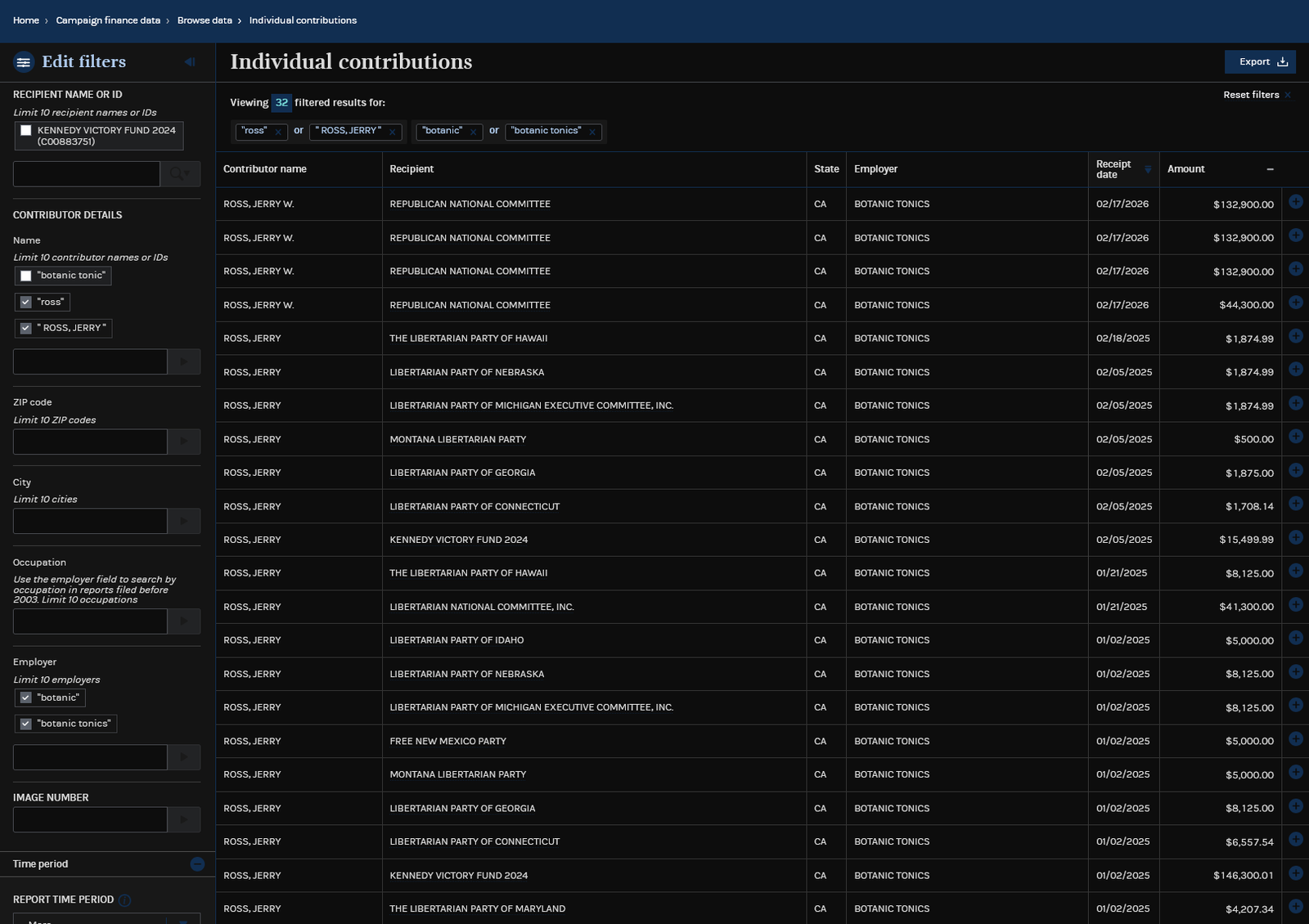
$146,300.01 on Jan 2 and $15,499.99 on Feb 5. On Jan 2 he also gave $14,207.34 directly to three small parties. His direct personal giving on the FEC record totals $182,607.34.
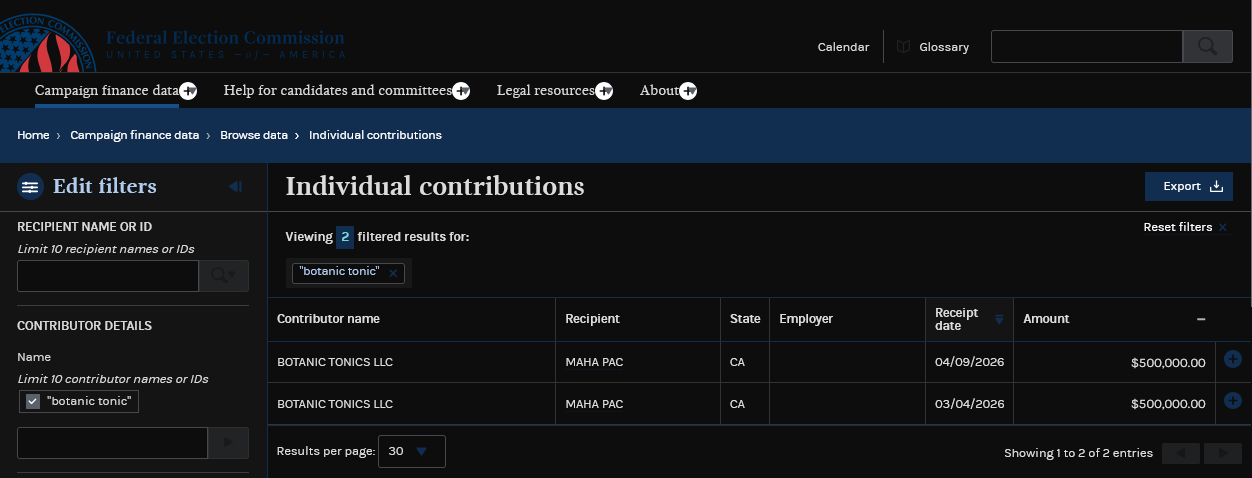
FEC Schedule A records for Ross, captured Oct 2, 2026. Thirteen of the Libertarian Party rows are memo entries: shares of the Kennedy Victory Fund money, passed through joint fundraising and already counted in the $161,800. Adding them again double-counts.
$182,607.34$182,607.34Bucket one: Ross's direct personal giving
Why it matters
This is his own money. The RNC money and the PAC money further down are separate, and we never add them to it.
FEC Schedule A, contributor Jerry W. Ross (Disclosure filing, no public link)
Checkmate reported income from the LLC every quarter from Q3 2025 through Q2 2026, $750,000 in all. The campaign targets concentrated products and defends natural botanicals.
Ohio canceled a pharmacy-board meeting and paused its ban effort. Governor Mike DeWine acknowledged contact from the health secretary.
Why it matters
Ross had given to Kennedy's campaign committees. Those were payments to political committees, not to HHS. Nothing in the record connects them, and we are not saying it does.
US 12,419,927, inventor Jerry Wayne Ross, claims kava CO2 extract in liquid with ground kratom leaf. One claim specifies leaf substantially free of 7-OH.
A federal judge gave final approval to a class settlement against Botanic Tonics and Hydra623 Holdings over Feel Free's disclosures, after preliminary approval on Mar 5. 7-Eleven was a co-defendant. The order says it is not an admission.
FDPS's 2024 return reports $55,194 paid to two firms of Kevin Sabet's, LUA Partners ($30,194) and Policy Solutions Group ($25,000), disclosed as related-party business. It reports zero employees and also $117,987 paid to Luke Niforatos.
FDPS 2024 Form 990 and Schedule L, filed Nov 13, 2025 (Disclosure filing, no public link)
From 2015 to 2025, poison centers reported 233 deaths where kratom was found, about 21.2 a year, and 79% involved other drugs. In 49, kratom was the only substance: about 4.5 a year.
4.54.5Deaths a year, kratom the only substance
21.221.2Deaths a year, kratom involved
Why it matters
Poison center reports for ages 12 and up, not every death in the country. It is still the federal count, and the single-substance row is small.
CDC MMWR 75(11), March 2026 (Study or data, no public link)
Markwayne Mullin's nominee report, signed Mar 10, lists Botanic Tonics LLC at $500,001 to $1,000,000, with income of none or less than $201. His Mar 17 ethics agreement lists 62 stocks and 19 bonds to sell. Botanic Tonics is not among them.
OGE Form 278e, line 25. The crop shows the entry line without the column header.
Why it matters
Homeland Security does not oversee DEA, which sits in the Justice Department. The stake still puts a cabinet secretary's money in a kratom drink company.
Led by Pete Ricketts and Richard Blumenthal, with Marsha Blackburn, John Boozman, Katie Britt, Ted Budd, Mike Crapo, Steve Daines, Jim Justice, Alex Padilla and Jeanne Shaheen. FDPS says it helped draft the letter. The senators did not credit it.
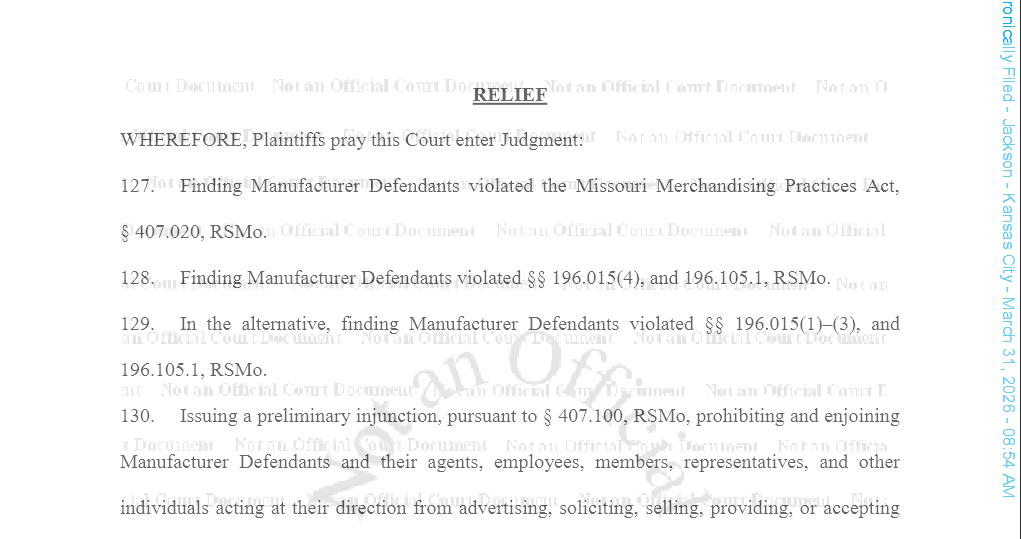
The petition, filed in Jackson County, asks for an injunction barring the manufacturer defendants from selling any kratom product. GKC thanked her, calling the suit aligned with "the federal distinction" between leaf and synthetics.
Paragraph 130 of the petition, filed Mar 31, 2026. The sentence continues past this crop to reach any kratom product.
Why it matters
A group that says it defends the leaf praised a suit that reaches the leaf.
CBD American Shaman and Relax Relief Rejuvenate Trading settled with the attorney general. The terms bar selling "7-OH, dihydro-7-hydroxymitragynine also called MGM-15, mitragynine, mitragynine pseudoindoxyl, or paynantheine" in Missouri. One company said it had sold only concentrated 7-OH.
Why it matters
The case was about concentrated products. The settlement list names mitragynine, the leaf's main alkaloid, too. Go after one kratom alkaloid and the others follow.
NIDA's Phase 1 trial will give single oral doses of 25 to 100 mg of mitragynine to 32 healthy adults who used oral opioids in the past month, and measure safety. Its listing says some people use mitragynine on their own to help manage symptoms of opioid withdrawal. It does not test whether mitragynine treats opioid use disorder. As of October 2026 the listing still said not yet recruiting.
Why it matters
The government is paying to test kratom's main alkaloid in people, the same alkaloid the body turns into 7-OH, while DEA moves to schedule 7-OH.
Administrator Terrance Cole signed notices covering 7-OH by threshold and the derivatives MGPI, MGM-15 and MGM-16. HHS said the action was "not intended to regulate natural leaf kratom."
The 7-OH notice (91 FR 40917) draws a line at 0.050% 7-OH and strips the exemption from material that is synthesized, chemically converted, concentrated, enriched or isolated. DEA says no safe consumption limit has been established. It also calls 7-OH "a known metabolite of mitragynine." A second notice covers MGPI, MGM-15 and MGM-16. HHS opened a request for information.
Why it matters
7-OH forms from mitragynine by oxidation during ordinary handling. Chemically converted is a phrase a leaf product can trip over.
America's Poison Centers counted 593 7-OH reports in 2025 and 901 in the first half of 2026. Among reports involving 7-OH alone, 20.5% were hospitalized. The advisory gives no death count. DEA's notice says poison centers only got codes for 7-OH between February and May 2025.
Why it matters
This is the strongest number on the other side, and it belongs here. Part of the climb is poison centers starting to code 7-OH in 2025, and hundreds of calls a year, for products sold online and in gas stations and smoke shops, is a small number. The answer is testing, a dose on the label and a legal shelf, not a ban or a cap.
DEA published a proposed rule to schedule tianeptine through the permanent 811(a) process, with comments through Aug 7. It drew 188. The kratom compounds went through 811(h), with no DEA comment docket. HHS ran its own.
Gour, McCurdy and colleagues tested semisynthetic products, not leaf, and called for oversight. The paper was published online Jul 14. The university's release followed Jul 30.
Why it matters
Mislabeled concentrates are an argument for testing and honest labels. The authors asked for oversight, not scheduling.
Lilly will pay $6.75 a share plus contingent payments tied to two depression programs, BPL-003 and VLS-01. The deal closed Sep 11. The merger proxy never mentions mitragynine, kratom or Kures. Kures' rights went back to Columbia in 2024.
Ranking member Ron Wyden's letters ask, in question 12, when Secretary Mullin acquired his stake and which other officials hold stakes. Answers were due Aug 31.
The Los Angeles County Medical Examiner ruled the NBA player's death an accident caused by the effects of heroin and cocaine. Mitragynine was one of eight substances detected. It is not named as the cause.
Why it matters
Headlines tied his death to kratom. This is a death where kratom was found, and the ruling names heroin and cocaine.
Sen. Bernie Moreno's S.5383 exempts botanical products under three limits: 1 mg of 7-OH per gram, 1 mg per milliliter, and 1 part 7-OH per 100 parts mitragynine. It restricts concentrates, and it says no one may be prosecuted solely for simple possession. It went to Senate Judiciary.
Why it matters
Republicans wrote a possession protection into a federal bill, and that part is worth keeping. The 1 mg lines are caps, and we oppose caps on any kratom alkaloid.
The state epidemiologist told a legislative working group that mitragynine, 7-OH or MGPI were part of the primary cause in 23 of the deaths since 2021, plus 1 where they contributed. Poison calls went from 7 in 2024 to 22 in 2025.
Why it matters
Both numbers are the state's. The 50 is what the order cited. The 23 is how many had kratom compounds in the primary cause.
North Dakota Monitor, Aug 12, 2026 (Reported, no public link)
DEA's temporary order covers the three derivatives through August 2028, with no threshold for MGPI, which can form from 7-OH. The same day, AKA sued DEA, asking only that the order be read not to reach traditional leaf with trace, naturally formed MGPI. AKA says it does not challenge the scheduling itself.
Why it matters
There is still no order on 7-OH. There is a notice, and nothing else.
From university records: travel paid by the association, more than $100,000 from AKA's Center for Plant Science and Health to the University of Florida, and McCurdy's own estimate of $1 million in industry money reaching his research through the university foundation.
Why it matters
The money should have been disclosed. Most of his research is NIDA-funded and he works for both sides, so judge each study on its data.
ProPublica, Sep 1, 2026 (Reported, no public link)
Gov. Kim Reynolds and state health officials issued a public warning. It was a warning, not a ban or an order. The release calls them "kratom-associated" deaths, confirmed across 23 counties.
A study at the Michael E. DeBakey VA Medical Center in Houston, led by a Baylor College of Medicine researcher, began recruiting 72 people with past recreational opioid use. It gives single doses of 4 to 16 grams of kratom in capsules, 30 mg of oxycodone or a placebo. Its main measure is how much people like the drug.
Why it matters
A drug-liking test against oxycodone is how abuse potential gets measured. Watch where the results end up.
SB2408 had passed the Senate 46-1. The same day, the governor signed HB1628 instead: synthetic kratom banned, natural kratom limited to adults 21 and over, a 2% cap and a $10,000 license. He rescinded his executive order.
Why it matters
One vote between a cap and making possession a crime. We want neither.
Boulder Care says kratom users were 3% of new patients in September 2025, 8% in July 2026 after Tennessee's ban, and 14% in August. Recovery Centers of America says its Massachusetts sites went from about one kratom patient a week to 10 to 20.
Why it matters
People lose access and show up in withdrawal. These numbers are the first look at what happens after a ban.
No toxicology has been released. There is no published cause or manner of death and no finding that any substance was responsible. Court records, as reported, describe a tablet whose label listed MGPI, MGM-15 and 7-OH. Two of those had been Schedule I since Aug 26. We are not going to speculate about the students.
Why it matters
Lafayette County has banned kratom, possession included, since 2021. A labeled Schedule I synthetic was still allegedly sold there.
Mississippi DPS, Sep 30, 2026 (Official statement, no public link)
Lafayette County court records, as reported (Reported, no public link)
Attorney General Kris Mayes alleges Feel Free was sold as an energy and wellness drink while its kratom content and addiction risk were obscured. The suit does not ask to pull the product. It cites a state count of 146 kratom-related deaths from 2020 to 2023.
US 2026/0284136 A1 claims purified kratom alkaloids recombined, such as 7-OH without mitragynine. Nothing in the record links CaamTech to Botanic Tonics.
The Tenth Circuit had granted a motion to abate the appeal on Jul 29. On Sep 24 its docket recorded the case as terminated without a panel. No court ruled on the merits. The district case closed Sep 25.
The release's title describes a "suspected connection to death of one of two students." The same day, Lafayette County's narcotics unit called for legislative hearings.
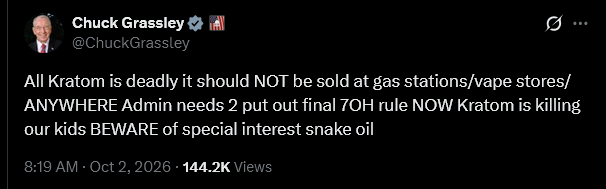
His post on X demanded a final 7-OH rule "NOW" and said kratom should not be sold anywhere. He chairs Senate Judiciary, where S.5383 has sat since Aug 8. He was not one of the 11 senators on the March letter.
Post on X, Oct 2, 2026, 8:19 a.m., 144.2K views.
Why it matters
The rule he demands only covers 7-OH above a threshold, and he wants the leaf gone too. That is why a 7-OH line is never just about 7-OH.